Preview every page
Read the document as you fill in the form.
Bill for a framing stage with lumber and a delivery charge. Replace the fictional example with your own work and agreed prices.
All set
Invoice rules in the US depend on your state. This tool helps you lay out an invoice; it is not tax advice.
These pictures show the same document generator with fictional example details.
Replace the example names and contact details in the form. Keep only information that belongs in this document.
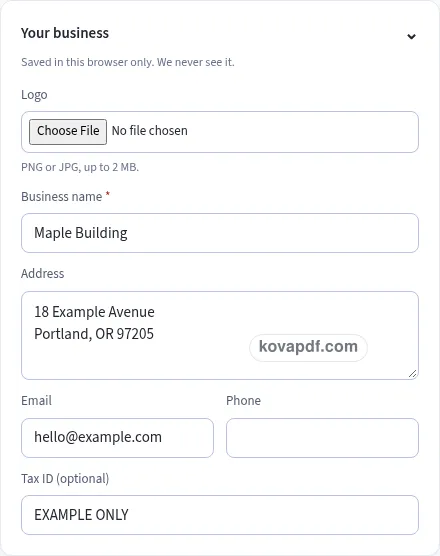
Check the page preview after changing the text. Read the amounts, dates and page breaks before exporting.
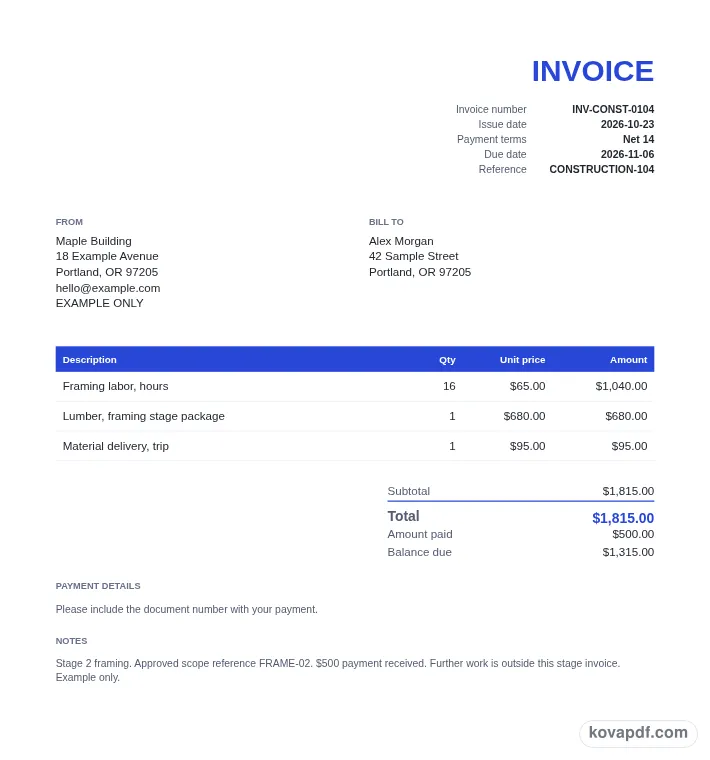
Use the download controls above the preview. Open the saved file and give it one final read before sharing.

Read the document as you fill in the form.
Compare Classic, Modern and Minimal layouts.
Save a copy when the names and figures are right.
The generator works on this device.
Use A4 or Letter and check the page breaks.
Return to the form to correct a detail before sharing.
These are fictional details. Choose an example, then replace them with your own.
Enter the customer and project reference. Replace the sample site and customer and crew time entries with the actual agreed work.
Read material package and previous payment. Put received money in Amount paid and compare the balance with your records.
Check stage balance in the preview. Save PDF or Word, open the file and read the job description and balance before sending.
This construction invoice template is a sample you can read and adapt section by section. It shows a framing stage with lumber and a delivery charge, with fictional details to explain the structure. Its purpose is to bill for a framing stage with lumber and a delivery charge. Review the wording as well as the empty fields: the client reviewing the construction work needs a document that reflects the actual situation, not merely a completed sample.
Read the construction invoice sample at the stage identification entry. Its fictional value is stage 2 framing, FRAME-02. A stage invoice should tell the reviewer which work belongs in this period rather than imply the whole project is complete. This is one part of a document intended to bill for a framing stage with lumber and a delivery charge. Follow it through to site and customer, then ask whether the two details express what you intend. Rewrite the draft where the sample does not fit; filling a box is only the beginning of that review.
Read the construction invoice sample at the site and customer entry. Its fictional value is the project address and billing customer. Confirm who approves invoices for this particular project. This is one part of a document intended to bill for a framing stage with lumber and a delivery charge. Follow it through to crew time, then ask whether the two details express what you intend. Rewrite the draft where the sample does not fit; filling a box is only the beginning of that review.
Read the construction invoice sample at the crew time entry. Its fictional value is sixteen framing hours. If several trades or rates are involved, separate them so the reviewer can compare like work with like work. This is one part of a document intended to bill for a framing stage with lumber and a delivery charge. Follow it through to material package, then ask whether the two details express what you intend. Rewrite the draft where the sample does not fit; filling a box is only the beginning of that review.
Read the construction invoice sample at the material package entry. Its fictional value is lumber for this framing stage. Keep later deliveries out of this stage unless they belong to the same bill. This is one part of a document intended to bill for a framing stage with lumber and a delivery charge. Follow it through to delivery, then ask whether the two details express what you intend. Rewrite the draft where the sample does not fit; filling a box is only the beginning of that review.
Read the construction invoice sample at the delivery entry. Its fictional value is one material delivery trip. A delivery entry should describe what was charged rather than leave the reviewer to infer it from a general materials line. This is one part of a document intended to bill for a framing stage with lumber and a delivery charge. Follow it through to previous payment, then ask whether the two details express what you intend. Rewrite the draft where the sample does not fit; filling a box is only the beginning of that review.
Read the construction invoice sample at the previous payment entry. Its fictional value is 500 received against this invoice scope. Reusing a project-wide deposit on several stage invoices can overstate the money already applied. This is one part of a document intended to bill for a framing stage with lumber and a delivery charge. Follow it through to scope changes, then ask whether the two details express what you intend. Rewrite the draft where the sample does not fit; filling a box is only the beginning of that review.
Read the construction invoice sample at the scope changes entry. Its fictional value is a reference to approved additional work. If a charge remains under discussion, resolve how it should be presented rather than hiding it among the original items. This is one part of a document intended to bill for a framing stage with lumber and a delivery charge. Follow it through to stage balance, then ask whether the two details express what you intend. Rewrite the draft where the sample does not fit; filling a box is only the beginning of that review.
Read the construction invoice sample at the stage balance entry. Its fictional value is 1815 total, with 1315 remaining in the example. This sample uses fictional prices and no added tax; it is not a schedule of project completion percentages. This is one part of a document intended to bill for a framing stage with lumber and a delivery charge. Follow it through to stage identification, then ask whether the two details express what you intend. Rewrite the draft where the sample does not fit; filling a box is only the beginning of that review.
The sample separates the information you type from the wording built around it. Read both parts when adapting the construction invoice. Changing stage identification does not tell you whether every paragraph fits your circumstances. Look especially at scope changes and compare the finished passage with what you intend to record. The Text area lets you review generated paragraphs and make an intentional change where the form supports it. Read the complete result afterwards, since a change to one passage can affect how another is understood. Keep a draft for review before using a final copy. The example concerns a framing stage with lumber and a delivery charge; it is not a statement about the arrangements, facts or legal requirements that apply to someone using this page.
It needs your own details and review. Read the section about scope changes alongside stage balance. A sample demonstrates structure; it cannot decide whether the document is suitable for your circumstances.
Work through the form and then read the complete generated text. Start with stage identification, check the context of delivery, and change wording that does not express what you intend. Keep a copy of the checked draft.
Use the form to enter site and customer and then work through previous payment. The preview updates from your entries. All names and figures in the gallery are fictional and need checking before use.
PDF preserves the previewed page arrangement. Word provides editable text and may reflow when opened. Use the current draft to bill for a framing stage with lumber and a delivery charge; whichever format you choose, inspect the saved copy before sharing it with the client reviewing the construction work.
No. Download the checked copy, then choose how to share it. Your entries are used on this device. On a shared computer, clear the saved draft when you no longer want those details stored in the browser.