Preview every page
Read the document as you fill in the form.
Summarize account activity over a stated period. Compare the filled example, check each detail and save your own copy.
All set
These pictures show the same document generator with fictional example details.
Replace the example names and contact details in the form. Keep only information that belongs in this document.
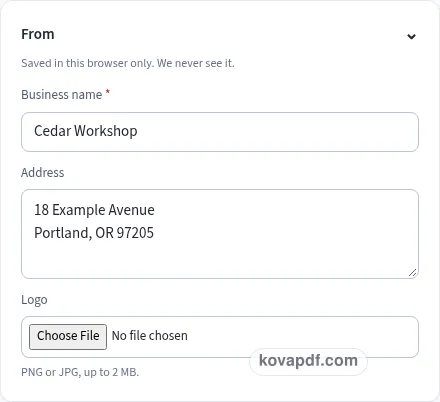
Check the page preview after changing the text. Read the amounts, dates and page breaks before exporting.
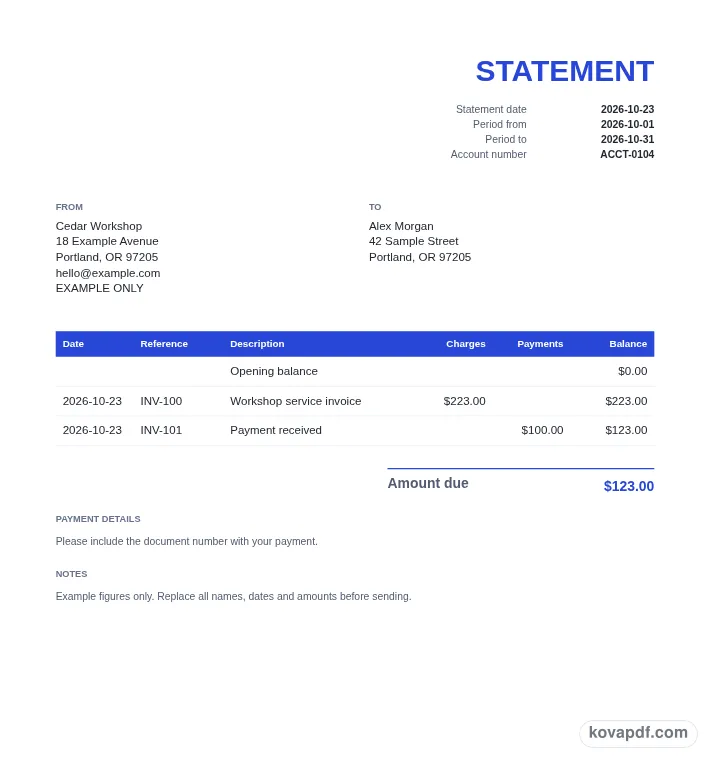
Use the download controls above the preview. Open the saved file and give it one final read before sharing.

Read the document as you fill in the form.
Compare Classic, Modern and Minimal layouts.
Save a copy when the names and figures are right.
The generator works on this device.
Use A4 or Letter and check the page breaks.
Return to the form to correct a detail before sharing.
These are fictional details. Choose an example, then replace them with your own.
Start with account number and statement period. Replace the fictional sample with information from your own records.
Check entry date beside transaction reference. Read each page from the perspective of a customer reconciling invoices and payments.
Choose PDF or Word above the preview. Check closing balance in the saved copy before sharing it.
A simple statement of account leaves space for the details that matter to a customer reconciling invoices and payments. The Minimal style keeps decoration quiet while you summarize account activity over a stated period. The illustration shows a month with an opening balance, new charges and a payment. Replace that example with your own information and keep enough context for a reader who was not part of the original conversation.
Keep account number specific in a simple statement of account. Here, aCCT-0104 shows the sort of entry to replace. Keep it distinct from the number of any individual invoice appearing in the statement. Minimal uses less decoration, which leaves the actual statement of account wording doing more of the work. Check statement period as well. Shortening an entry is useful only when a customer reconciling invoices and payments can still understand what it means.
Keep statement period specific in a simple statement of account. Here, october 1 through October 31 shows the sort of entry to replace. Make sure the opening balance belongs to the start of that period. Minimal uses less decoration, which leaves the actual statement of account wording doing more of the work. Check opening balance as well. Shortening an entry is useful only when a customer reconciling invoices and payments can still understand what it means.
Keep opening balance specific in a simple statement of account. Here, the balance before the first listed entry shows the sort of entry to replace. A wrong opening value can make every running balance misleading even when the later entries are correct. Minimal uses less decoration, which leaves the actual statement of account wording doing more of the work. Check entry date as well. Shortening an entry is useful only when a customer reconciling invoices and payments can still understand what it means.
Keep entry date specific in a simple statement of account. Here, the date of each charge or payment shows the sort of entry to replace. The statement orders the entries by date so the balance can be followed through the period. Minimal uses less decoration, which leaves the actual statement of account wording doing more of the work. Check entry type as well. Shortening an entry is useful only when a customer reconciling invoices and payments can still understand what it means.
Keep entry type specific in a simple statement of account. Here, invoice, payment, credit note or adjustment shows the sort of entry to replace. A payment or credit changes the balance differently from a new invoice charge. Minimal uses less decoration, which leaves the actual statement of account wording doing more of the work. Check transaction reference as well. Shortening an entry is useful only when a customer reconciling invoices and payments can still understand what it means.
Keep transaction reference specific in a simple statement of account. Here, iNV-0104 or a payment reference shows the sort of entry to replace. A statement should help the customer find the underlying detail rather than replace it. Minimal uses less decoration, which leaves the actual statement of account wording doing more of the work. Check entry amount as well. Shortening an entry is useful only when a customer reconciling invoices and payments can still understand what it means.
Keep entry amount specific in a simple statement of account. Here, the amount recorded for that transaction shows the sort of entry to replace. Avoid entering the same payment twice because it appears in two different bank or customer records. Minimal uses less decoration, which leaves the actual statement of account wording doing more of the work. Check closing balance as well. Shortening an entry is useful only when a customer reconciling invoices and payments can still understand what it means.
Keep closing balance specific in a simple statement of account. Here, the amount after the last listed entry shows the sort of entry to replace. A statement summarizes activity; it should not be confused with a new invoice for every listed charge. Minimal uses less decoration, which leaves the actual statement of account wording doing more of the work. Check account number as well. Shortening an entry is useful only when a customer reconciling invoices and payments can still understand what it means.
Use the extra visual space in the simple statement of account to make the wording precise. For example, invoice, payment, credit note or adjustment gives more context than a label copied without thought. Keep that context if a customer reconciling invoices and payments would otherwise need to ask what the entry covers. Read entry amount separately from the heading: a plain layout still needs the details that explain the situation. The Design controls let you compare paper sizes without rewriting your text. After changing size, read the page breaks and the final lines in Preview. If the statement of account needs another page, keep the necessary wording. A simple document is one the intended reader can follow, even when a month with an opening balance, new charges and a payment requires more than a short note.
Keep the information needed to summarize account activity over a stated period. Simpler styling does not mean omitting entry date or making transaction reference unclear. Review optional entries individually instead of removing detail just to shorten the page.
Yes. Length follows the text and entries you provide. The Minimal design is a visual choice rather than a one-page promise. Read each page, including the final closing balance entry, before downloading.
Use the form to enter statement period and then work through transaction reference. The preview updates from your entries. All names and figures in the gallery are fictional and need checking before use.
PDF preserves the previewed page arrangement. Word provides editable text and may reflow when opened. Use the current draft to summarize account activity over a stated period; whichever format you choose, inspect the saved copy before sharing it with a customer reconciling invoices and payments.
No. Download the checked copy, then choose how to share it. Your entries are used on this device. On a shared computer, clear the saved draft when you no longer want those details stored in the browser.