Graduate CV template
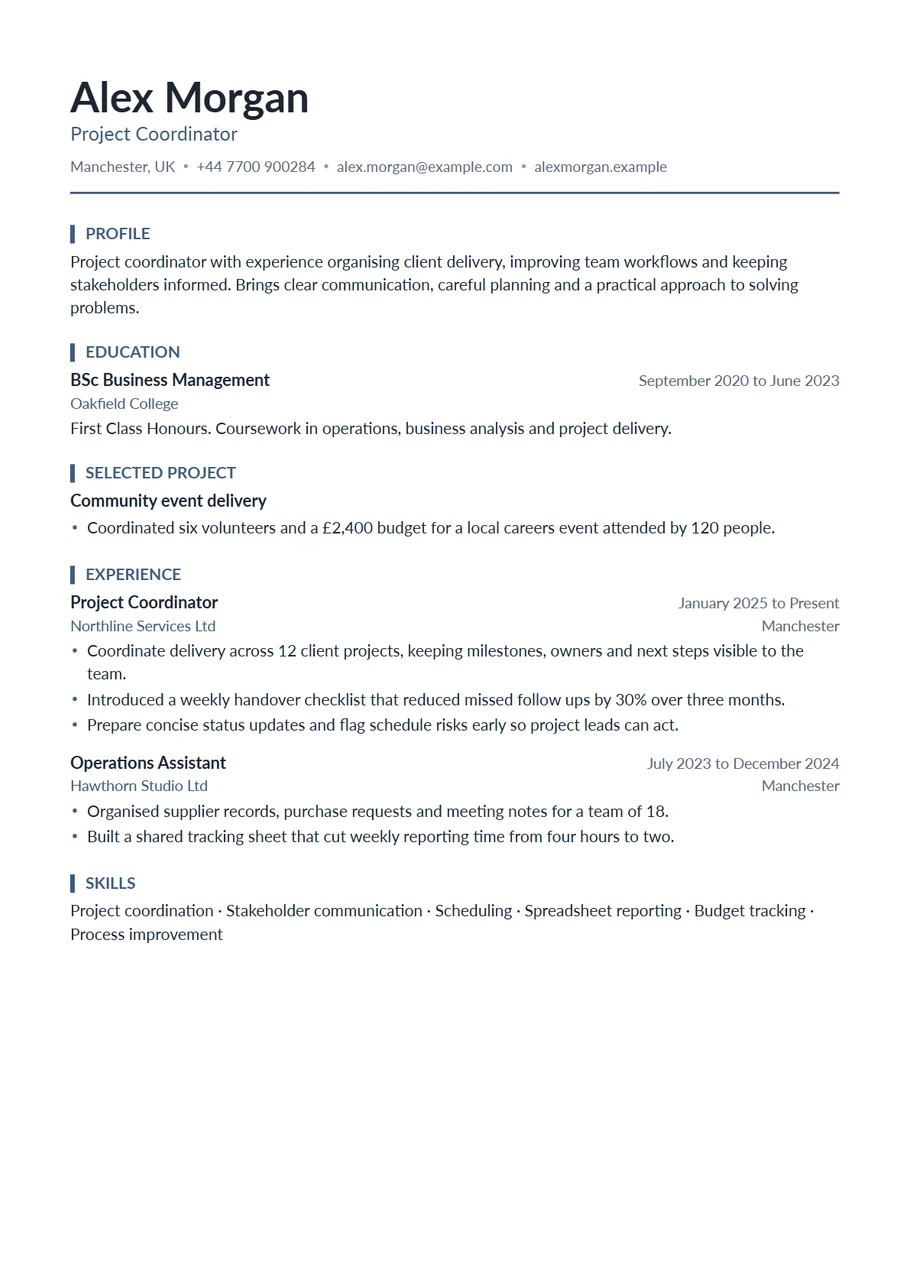
When your degree, apprenticeship or college course is the most relevant thing you have done, it should be the first thing the reader sees. This template, called Graduate in the CV Maker, moves Education to the top, follows it with Projects and only then lists work experience. You do not have to arrange anything: the order is set for you, and it changes back if you pick another layout later.
It is meant for final year students, recent graduates, school leavers applying for apprenticeships, and anyone changing career after retraining, where the course matters more right now than the jobs that paid the bills.
Free, no account needed. Your CV is built in your browser and downloads as a PDF or an editable Word file, in A4 or US Letter.
What to put in each section
- Profile: two or three lines naming your course, what you want to do with it, and one strength you can prove. For example: Business management graduate looking for an operations or project support role, with two years of part time retail supervision.
- Education: your degree or course title, institution, start and end dates, and your grade or predicted grade. Add two or three modules or a dissertation title that relate to the job. Put A levels, Highers or a high school diploma underneath in one line.
- Projects: one to three pieces of work with a result. A group project, a dissertation, a society event, a hackathon, a placement brief. Say what you were responsible for, not just what the team made.
- Experience: part time, holiday and voluntary work all count. Bar work shows you can handle pressure and money; tutoring shows you can explain. Two lines per job are usually enough.
- Skills: software, languages, driving licence, first aid. Skip the soft skills list and let the projects and jobs show them.
How long a graduate CV should be
One page. Almost every graduate CV that runs to two pages has padding in it: school grades listed subject by subject, every module on the course, a hobbies section. The preview tells you when you spill onto a second page, and the fix is nearly always to shorten the oldest education and the least relevant job.
Example lines for students and graduates
- Led a team of four on a final year consultancy project for a local charity and presented the recommendations to its board.
- Wrote a 10,000 word dissertation on supply chain delays in small food businesses, using interviews with six owners.
- Supervised weekend shifts of five staff, cashed up the tills and opened and closed the store.
- Organised a careers evening for 120 students as events officer of the business society.
- Tutored two GCSE students in maths every week for a year; both improved by two grades.
- Built a simple booking website for a student theatre group, which it still uses to sell tickets.
If you do not have numbers, describe the size of the thing: how many people, how long, what was at stake. The fictional Alex Morgan sample on this page shows how a coursework line and a project line sit together.
What to leave out
- Every GCSE or school subject. One line such as 9 GCSEs including English and Maths is enough.
- A photo, unless you are applying somewhere that expects one.
- Phrases like hard working team player with excellent communication skills. Show it in a project line instead.
- A references section. Most employers ask later, and a lecturer or manager would rather be asked first.
Placements, internships and summer jobs
A year in industry or a summer internship is the most valuable thing on most graduate CVs, and it deserves more than a line. List it under Experience with the same detail as a full time job: what team you were in, what you were trusted with, and one result. If it was directly relevant to the job you want now, you can move Experience above Projects in the editor so the placement sits right under your degree. Unpaid work counts the same way; describe the work, not the pay.
Student resume or graduate CV?
In the UK the document is a graduate CV and A4 is standard. In the US it is a student or entry level resume on US Letter, and it often includes a GPA if it is 3.0 or higher, relevant coursework and campus activities. The layout handles both: switch the paper size above the preview, and rename Projects to Relevant experience or Campus involvement if that suits the job better.
Start with the Graduate layout
The CV Maker opens with this template chosen. Fill in one section at a time and watch the page update beside the form. If you change your mind, switch layout on the first step or the review screen: everything you typed comes with you.
Use the Graduate templateQuestions about this template
Can I put work experience above education later?
Yes. Move any section up or down in the editor and the template keeps your order instead of its own. Or switch to the Simple or Modern template, which lead with experience.
What if I have no work experience at all?
Use Projects, volunteering and any responsibilities at school or university. Turn off the Experience section rather than leaving it empty; empty sections are left out of the file anyway.
Should I include my grades?
Include a final or predicted degree grade if it is a 2:1 or above, or a GPA of 3.0 or more for US applications. If the grade does not help you, leave it off rather than explaining it.
Is this template suitable for an apprenticeship application?
Yes. Put your college course or school qualifications under Education, any practical work or projects under Projects, and part time jobs after.