Executive resume template
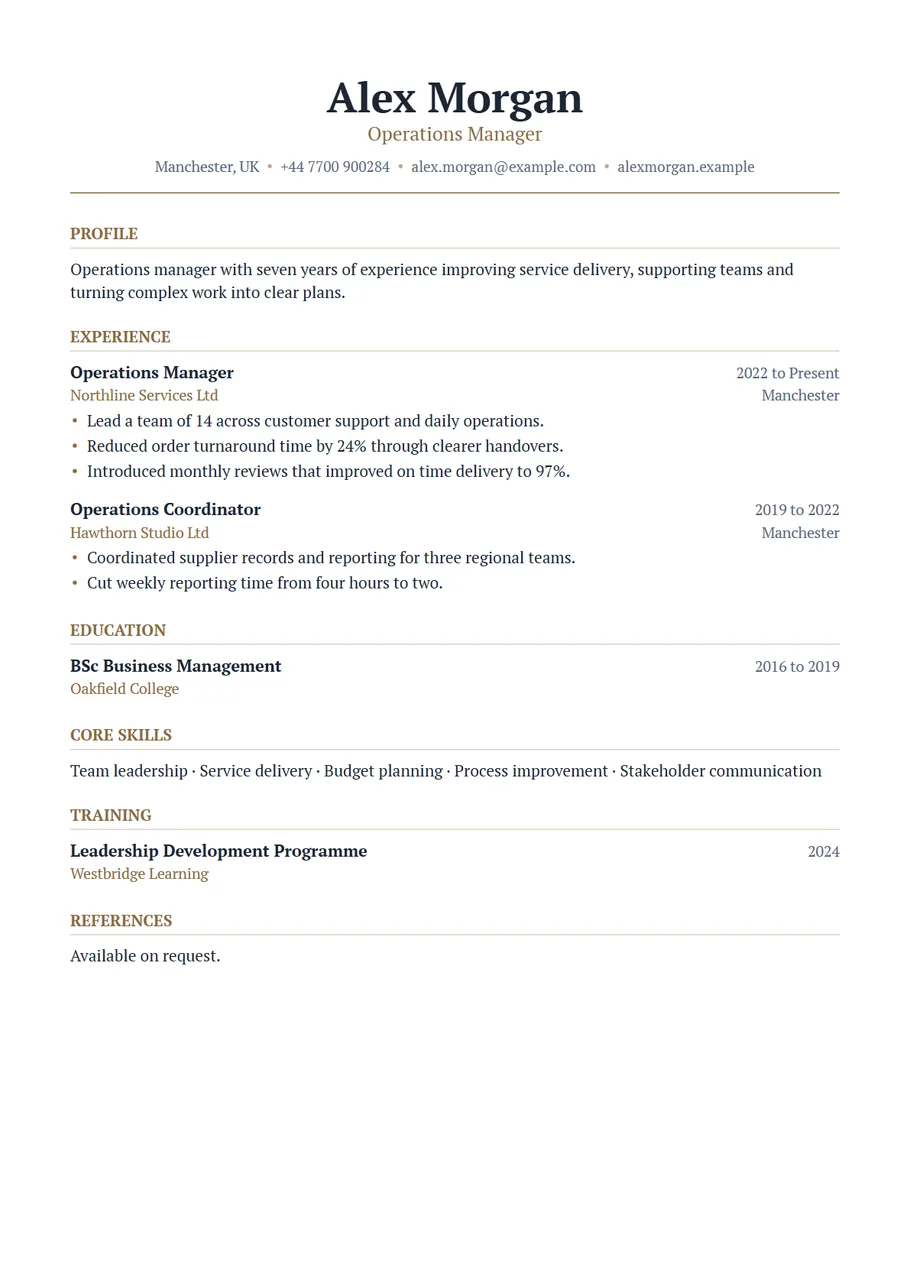
An executive resume is read by people with very little time: a chief executive, a board member, a search consultant with forty other candidates. They want to know the size of what you ran, what changed while you ran it, and whether that matches the job on their desk. This template, called Executive in the CV Maker, gives the page a more formal look and then gets out of the way: a centred serif name, a fine bronze rule, and one column that starts with your most recent role.
It works equally well as an executive CV for UK applications. The difference is mostly paper size and length, covered below.
Free, no account needed. Your CV is built in your browser and downloads as a PDF or an editable Word file, in A4 or US Letter.
What an executive resume should show
Scope first, then results. For each senior role, the first line should tell the reader what you were responsible for: the size of the team, the budget, the number of sites or the revenue line. The next two or three lines say what changed because of your decisions. Responsibilities on their own read like a job description; results on their own lack context. Together they show judgement.
- Profile: three lines. Your level, your sector and the problem you are known for solving. For example: Operations director with fifteen years in multi site logistics, known for turning around underperforming regions.
- Experience: the last ten to fifteen years in detail, most recent first. Earlier roles in one line each, or a single line such as Earlier roles in operations at two national retailers.
- Education and professional qualifications: degree, MBA, chartered status. No grades or dates needed for qualifications more than fifteen years old.
- Core skills: a short line of areas you lead, such as commercial negotiation, change programmes, P&L ownership.
- Board, trustee and advisory roles, and leadership training, as extra sections.
- References: Available on request. At this level, referees are usually contacted late and by arrangement.
Example lines for senior roles
- Led a team of 140 across three distribution centres with an annual budget of £12m.
- Reduced order to delivery time from five days to three by redesigning the regional hub network.
- Negotiated a three year carrier contract that cut transport costs by 9% without changing service levels.
- Reported monthly to the board on performance, risk and capital spend.
- Built a leadership pipeline that filled four of six senior vacancies internally over two years.
The fictional sample on this page uses an operations manager at a smaller scale, so the numbers are modest. Use your own, and only ones you can explain in detail.
Length: two pages is normal
Unlike a first job CV, an executive resume can run to two pages, and for a long career it usually should. What matters is that page one holds the case on its own: the profile and the most recent two roles. If the reader stops there, they should already know why you are on the list. Older roles, education, board positions and training can sit on page two.
What to leave out
- Every responsibility from your contract. Choose the three that matter for the job you want.
- Generic phrases such as visionary leader or results driven executive.
- A long list of software skills. At this level they are assumed.
- Graduation years if they give away more about your age than about your career.
- Salary history, unless a recruiter asks for it separately.
- Reasons for leaving each role. If there is a story behind a short stay, tell it in the interview.
Board, trustee and non executive roles
Non executive and trustee positions say a lot about how peers see you, and they often matter to a search panel as much as your day job. Give them their own section after experience, with the organisation, your role on the board, the years and one line on the committee work or decision you contributed to. Keep advisory roles that are only a name on a website off the page; an interviewer will ask what you did there.
US resume and UK CV at executive level
A US executive resume is printed on US Letter and leans hard on numbers and outcomes. A UK executive CV is on A4, may carry a slightly longer profile and often lists professional memberships. Switch the paper size above the preview; everything else in the layout stays the same.
This page is about the layout and what goes in it. For a longer, step by step piece on the writing itself, with more worked examples, read executive CV template: how to write one for a management role on our blog.
Start with the Executive layout
The CV Maker opens with this template chosen. Fill in one section at a time and watch the page update beside the form. If you change your mind, switch layout on the first step or the review screen: everything you typed comes with you.
Use the Executive templateQuestions about this template
How is an executive resume different from a normal one?
It focuses on scope and outcomes at a senior level: team size, budget, decisions and results. It can be two pages, and older roles are summarised rather than listed in full.
Should an executive resume have a photo?
Not for US or UK applications. If you are applying somewhere a photo is expected, use the Portrait template with the same details.
Can I add board or trustee roles?
Yes. Add a Custom Section or Professional Memberships from Extra sections and rename the heading to Board and advisory roles.
Does the Executive template change the section order?
No. It keeps the order you set, with experience first by default. Only the heading, the rule and the type change.